

125 years of the MOB
30.08.2026 Business, Business, Local News, NewsUpdate, Events, Editors Picks, Hôtellerie, MOB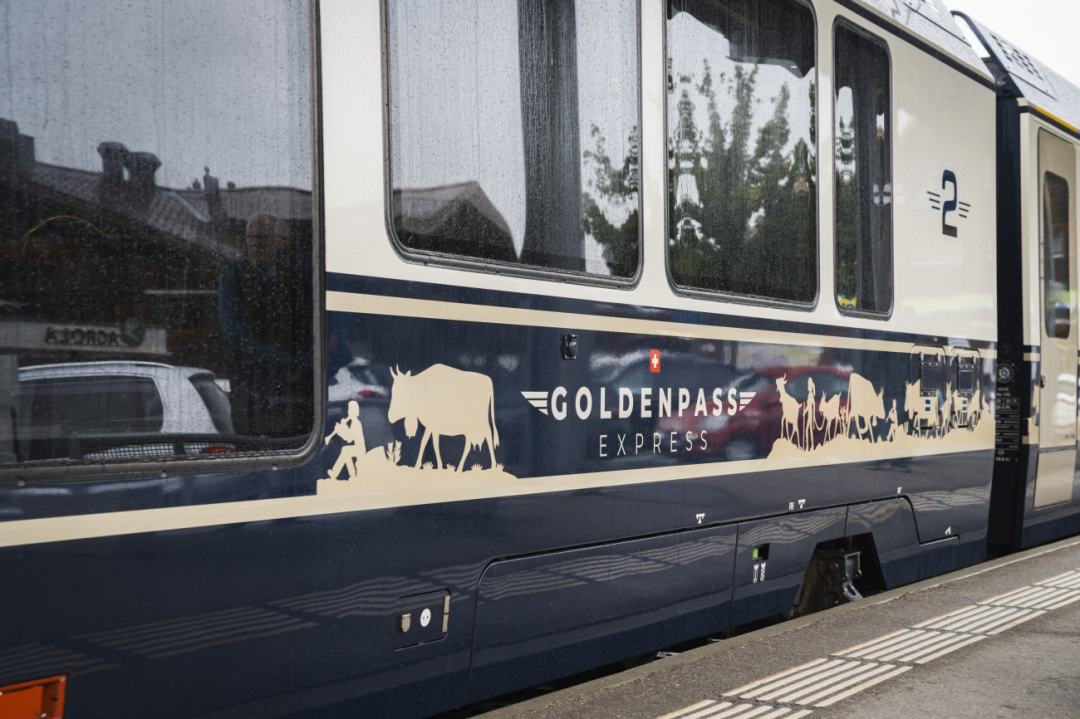
When the Montreux Oberland Bernois railway began operating 125 years ago, Gstaad was still a small village, and its inclusion on the route was anything but certain. Today, the MOB is inseparable from the story of the resort – and continues to connect Gstaad with the French-speaking part of Switzerland and beyond. The railway marked its anniversary on 21 August with around 120 invited guests in Gstaad.
The first section of the Montreux Oberland Bernois railway, better known as the MOB, opened between Montreux and Les Avants in 1901. Four years later, the line reached Zweisimmen.
That Gstaad found itself on the route at all was not a foregone conclusion.
At the beginning of the 20th century, routing the railway through what was then a small village was questioned, not least because it was technically unnecessary. The original plan would have taken the line directly from Saanen towards Schönried. Bernese politician Carl Reichenbach, however, campaigned strongly for Gstaad to be included.
The line through the village opened in 1905.
Speaking at the anniversary celebrations at Gstaad station, Saanen municipal president Petra Schläppi recalled the foresight and courage of the railway’s founders. Looking back at the decision to bring the MOB through Gstaad, her verdict was unequivocal: “That decision was worth its weight in gold for Gstaad.”
A new look for the anniversary
Appropriately for a railway celebration, the timing was precise. During the opening remarks by MOB Director General Yves Marclay, a GoldenPass Express wearing a new anniversary livery rolled into Gstaad station.
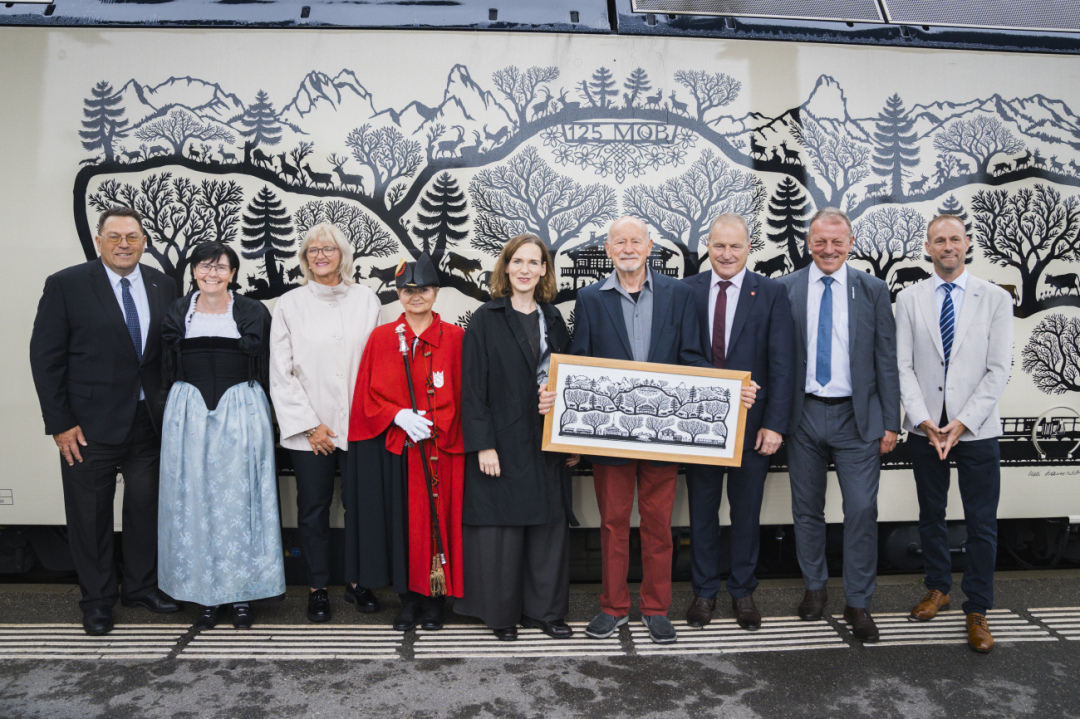
Its design is based on a traditional Swiss paper cut by Zweisimmen artist Ueli Hauswirth and brings together imagery from the three cantons the railway crosses: Vaud, Fribourg and Bern.
Marclay described the design as a meeting of tradition and innovation, memory and progress, roots and future. At its centre is what he called the “Röstibrücke” – a bridge across Switzerland’s traditional linguistic divide between the French- and German-speaking regions.
It is a playful variation on the familiar Swiss expression Röstigraben, but one that suits the MOB particularly well. For 125 years, its trains have carried residents, commuters, schoolchildren, soldiers and visitors back and forth across that divide.
Hauswirth, himself a former railway employee, appeared visibly moved when he saw his work on the train. The MOB had approached him following the Swiss paper-cutting exhibition, although he initially had no idea that his design would eventually cover a train.
From squeaking trains to the GoldenPass Express
The celebrations continued at the Gstaad Palace, where hotelier Andrea Scherz contributed a rather more mischievous chapter to local railway history.
According to a story dating from the 1960s, not everyone in Gstaad appreciated the noise of the passing trains. One evening, after a visit to the Bistrot, a group apparently decided to solve the problem themselves by applying a generous amount of grease to the tracks.
The following morning, there was indeed no squeaking.
Unfortunately, that was because the train could no longer make it up the gradient.
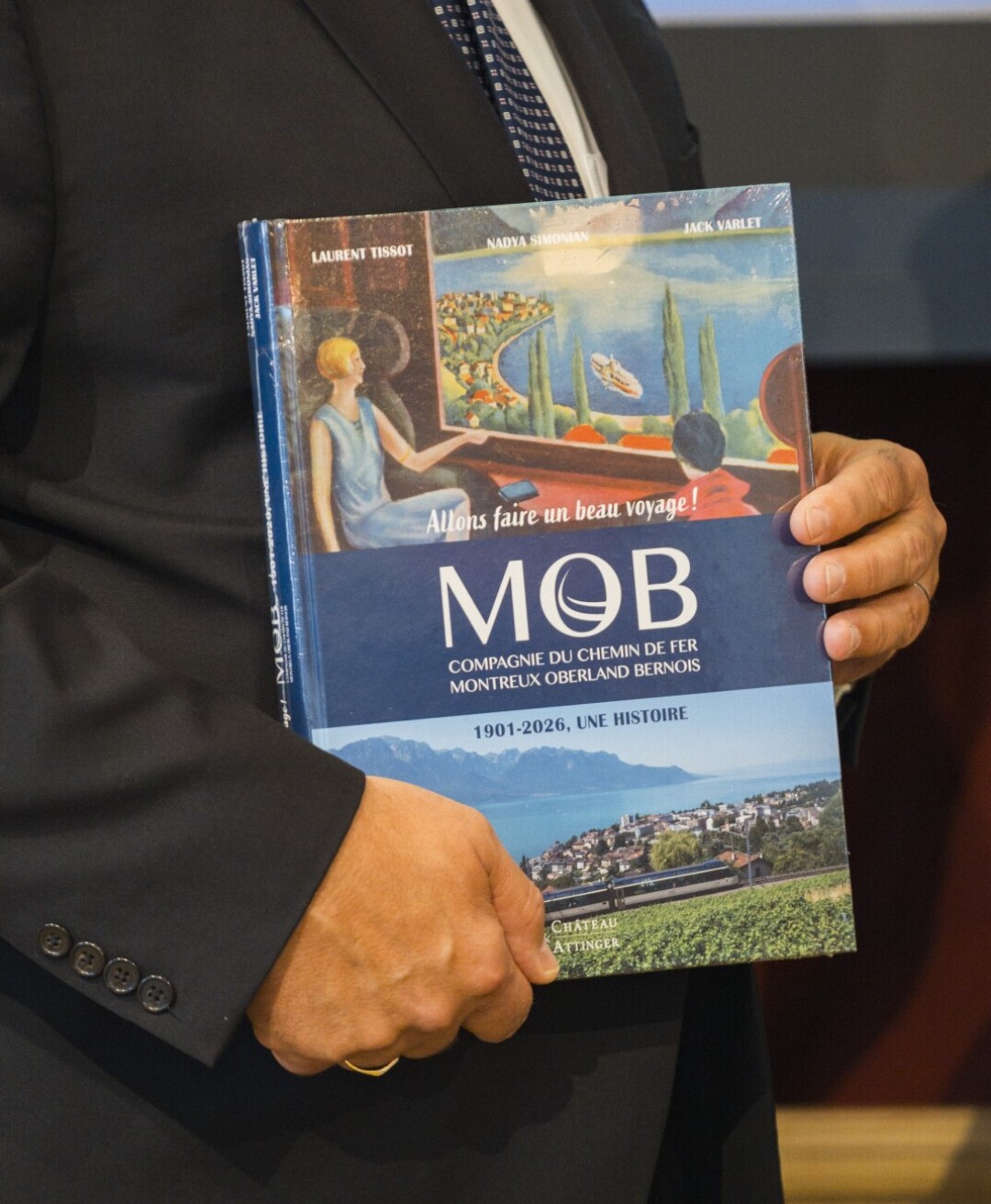
The anniversary also saw the presentation of a new 250-page book by Nadya Simonian, Laurent Tissot and Jack Varlet, tracing the MOB from its beginnings through to 2026. Kommen Sie mit auf eine schöne Reise! MOB 1901–2026 Geschichte und Geschichten – roughly, Come with us on a beautiful journey! MOB 1901–2026: History and Stories – combines the railway’s history with the stories that grew around it.
Among the international guests was a delegation from Japan’s Nankai Electric Railway, which has been a partner railway of the MOB since 2017. Managing Director Yuichi Imanaka spoke of his admiration for the passion and traditions of Swiss railways, and of the MOB in particular.
A railway between regions
The theme of connection ran throughout the anniversary.
Representatives from tourism, public transport and politics from Bern, Fribourg and Vaud joined federal representatives at the celebrations. Together, the three cantons and the Swiss Confederation hold more than 80% of the MOB’s shares.
Speakers including Bernese government councillor Evi Allemann, MOB chairman and Vaud National Councillor Laurent Wehrli, Vaud State Councillor Frédéric Borloz and Fribourg State Councillor Didier Castella looked back at the role the railway played in opening previously difficult-to-reach regions to both residents and tourism.
Castella summed up the wider point neatly: building bridges, he said, matters more than drawing borders.
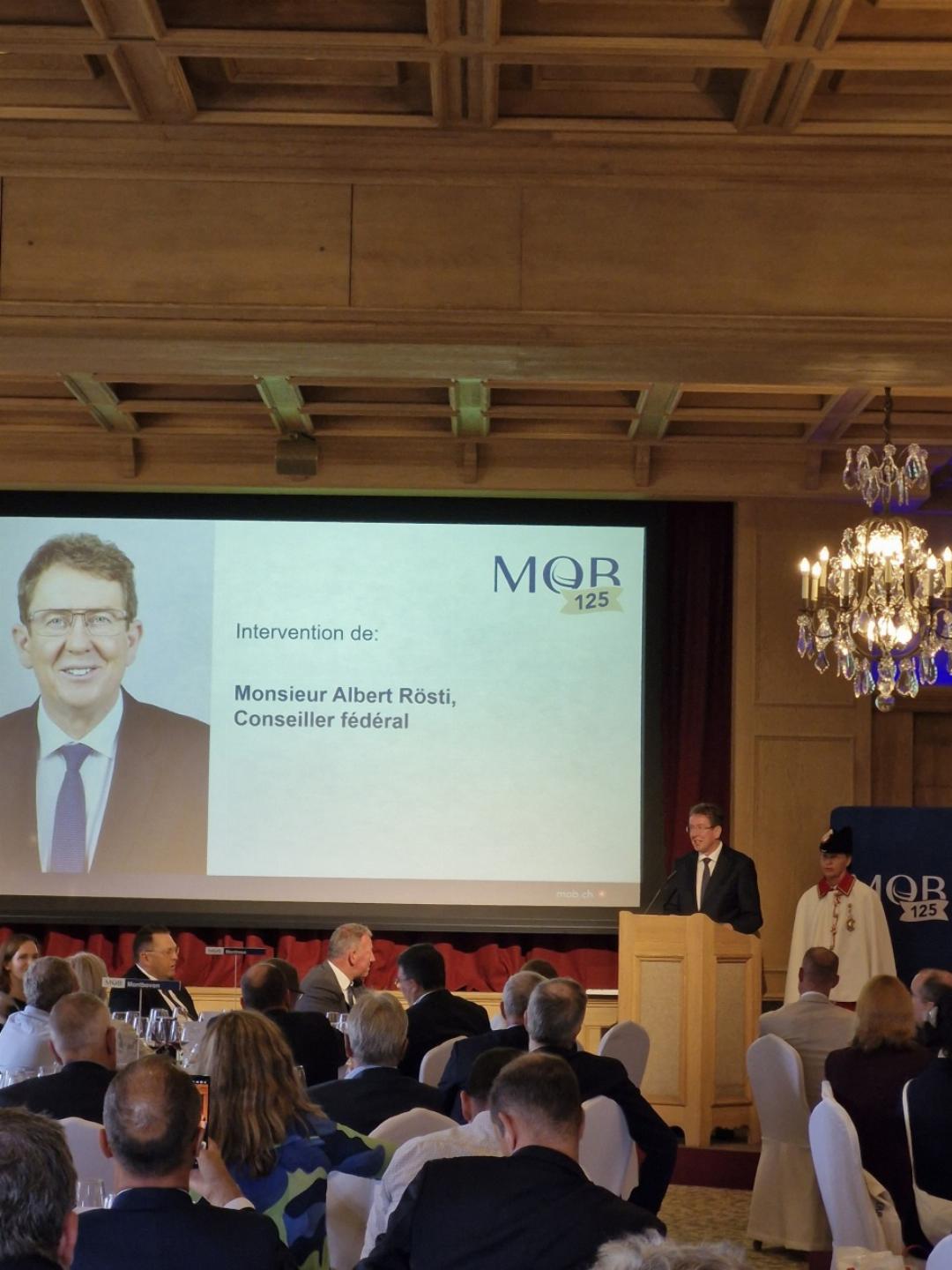
Federal Councillor Albert Rösti described the MOB as a “Suisse miniature” connecting town and country. Easier travel, he noted, had increased exchange between regions and changed society itself. He also argued that different forms of transport should complement rather than compete against one another.
Fittingly, the speeches shifted naturally between French and German.
The MOB may have changed considerably since its first train left Montreux in 1901, but one part of its purpose has remained remarkably consistent: connecting places that once seemed far apart.
For Gstaad, that connection proved particularly consequential.
Based on AvS by ELIANE ZÜRCHER | Edited for GstaadLife by jwi
MOB: 125 years in dates
1901
The first MOB section opens between Montreux and Les Avants.
1905
The line reaches Zweisimmen and becomes Switzerland’s first fully electrified railway line of its kind. Around 348,000 passengers and 5,700 animals are transported that year. Following Carl Reichenbach’s campaign, the line is routed through Gstaad rather than directly from Saanen towards Schönried.
1929
Passenger demand declines as car ownership becomes more widespread.
1930
For the first time, revenue generated at Gstaad station exceeds that of Montreux.
1939
With tourism collapsing, the Confederation, army and cantons support major infrastructure and rolling-stock improvements. The line also becomes strategically important to Switzerland’s wartime Réduit defence system.
1976
The MOB introduces its first panoramic coach – a world first on a narrow-gauge railway.
2022
The gauge-changing installation at Zweisimmen is officially inaugurated and the GoldenPass Express begins commercial services between Montreux and Interlaken. The MOB carries 2.81 million passengers that year.
2026
The MOB celebrates its 125th anniversary.