



INTERVIEW WITH FIONA THYSSEN
19.06.2026 Profile, Arts & Culture, Rougemont, Le Rosey, Traditions, Gstaad Living, Lifestyle, Profile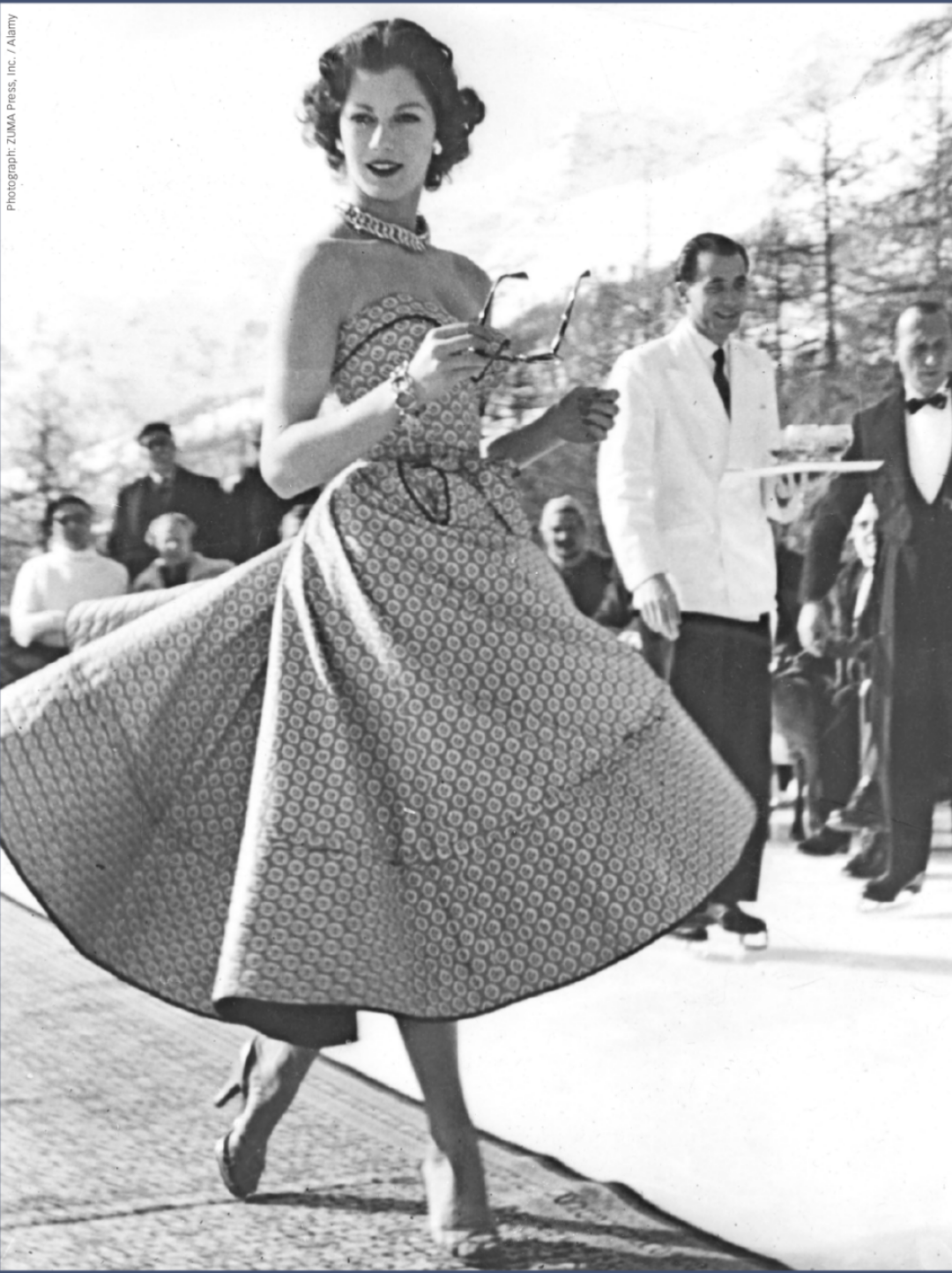
At 94, Fiona Thyssen has lived several lives. A country child in wartime Britain. A top model in the early days of Vogue. An active figure in the international art world. Now enjoying quieter days in Pays-d’Enhaut, Fiona met with GstaadLife to talk fashion, adventure and the importance ...
At 94, Fiona Thyssen has lived several lives. A country child in wartime Britain. A top model in the early days of Vogue. An active figure in the international art world. Now enjoying quieter days in Pays-d’Enhaut, Fiona met with GstaadLife to talk fashion, adventure and the importance of taking care of yourself.
What is your earliest fashion memory?
I must have been about five. In the early thirties, our children’s clothes were often made by my mother or nanny, and someone had made me a dress which I took one look at and absolutely refused to wear. I had quite a tantrum about it.
My mother was shocked. She insisted it was only a dress, but to me it looked like tapioca, which I hated. The fabric had a strange, lumpy weave. I refused to put it on, and it was taken away. Quite early on, I knew what I liked and what I did not like, and that it had to do with clothes. I would not wear the tapioca dress!
How did you end up in the modelling world; was that always a goal?
No, not at all. I had absolutely no intention of becoming a model. I never even thought about it.
We had been living a lovely country life, and when I was about seventeen or eighteen, my father had been posted to the Admiralty in London, and the whole family moved there with him. My mother saw two advertisements in the newspaper. One was for a secretarial course. The other was described as a finishing-school-type course, where you learned how to walk properly, apply make-up and so on. My sister chose the secretarial course, so I was given the other one.
I had no idea it was connected to modelling. The course was run by a modelling agency called Lucy Clayton. At the end, they approached me and said they thought I could do some modelling work. Would I be interested? I said yes, but I had not the faintest idea what modelling really involved.
At that time, there were very few clothes. The factories that had been making military uniforms had only recently adjusted to the end of clothing rationing, and were slowly making simple clothes, while the few couture houses were creating fashion. It was a very small, limited and exclusive world.
How did you move from those modest beginnings to Vogue?
Very slowly and with quite a lot of difficulty at first. I was a country girl, not glamorous or sophisticated. They cut all my hair off to make me look modern, which didn’t really work. I had no portfolio, and didn’t know how to find a photographer. I was completely blind.
In those early days, the technical process of taking photographs on plates was very slow, which meant you had to remain absolutely still. To help with this, they would pin the clothes in place with fine pieces of invisible string, like a butterfly fixed to a wall. But I was very healthy and coordinated and could stand very still, so I fulfilled that requirement. Then came the coronation of Queen Elizabeth II, and everybody wanted to look grand – what we’d call “snooty”. Luckily, I have a fine-boned face, which happened to be appropriate for looking grand and royal. So there were all these pictures in tiaras, showing readers what would be worn at the coronation. There was a whole fashion industry built around it, which is quite funny looking back.
Vogue used to do regular test shoots for new models. For mine, I was sent to Rigby and Peller to have a very expensive bathing suit made, then found myself wearing it on a freezing cold set. Norman Parkinson, who was doing the shoot, said, “Whatever happens, you keep smiling.” Then he went behind the camera, an assistant came up behind him and threw a bucket of cold water over me. The shock was enormous, but I smiled. He was impressed. That picture became my opening shot in Vogue, and it changed my life. That was the first time I realised there might be a real future for me in modelling.
From there, the work started coming. I was still a country girl underneath who happened to have a good face for the fashions of that time, but I was also a lady, and I knew how to behave. I got on well with photographers; I was very punctual, organised and disciplined. I was extremely modest and didn’t show off. So it just blossomed from there.
You worked with some of the biggest names in fashion photography. What was that like?
Cecil Beaton was probably the most famous. He only wanted “suitable” ladies in his pictures. One memorable moment was going to his country house with Suzy Parker, who was then the top American model. We walked in, and at the end of a great table were all his drawings for My Fair Lady. This was before the musical was staged. It felt like I was standing inside fashion history.
Later, we did a series together on Paris couture in the couturiers’ own homes. It was fascinating to see how they lived, not just the clothes they created. One of those pictures still appears from time to time in the British press. Cecil is a legend, so if you are associated with him, you are repeatedly recycled.
Then there were the more adventurous shoots. Henry Clarke loved to travel and often took me with him. On one trip, I worked with a live cobra on a terrace, which promptly insisted on hiding under my skirt rather than posing nicely for the camera. On another occasion, I found myself jumping around on a decorated elephant. Most of it was enormous fun.
Fashion has changed dramatically over your lifetime. How do you look at that shift from rationing to fast fashion?
I had to think about that when you asked. My view is that cheap air travel was one of the real triggers. After the war, English factories were still geared to making bombs, not dresses. Europe was flattened. There was no infrastructure for mass clothing production.
Once flying became more accessible, people could go to places like the Far East. There was labour, there were factories, there was space. You could suddenly have dresses made in quantity in other countries and bring them back to sell. That was the beginning of the ready-made market exploding. When I was a girl, everything was sewn at home or by a local dressmaker. Now it is the reverse. If someone makes a dress for you, it is an unusual, special, luxurious choice.
When you married Baron Hans Heinrich Thyssen-Bornemisza, you became part of one of the world’s major art-collecting families. How did that change your life?
It felt more like a continuation than a sharp change. My father was a very senior admiral. After the war, he was sent to Germany to help rebuild the German navy, a diplomatic role. We lived among embassies in Cologne. My parents entertained surviving German admirals. I watched how a big household was run and helped with that.
My mother was an artist and had always taken us to museums. I had been to art school myself, in a fairly modest way. So when I married and, with that, married into a great collection, it was a huge gift but not a completely foreign world. I learned about the business and the history behind the pieces. It gave my husband and me more to share.
It was not a conventional marriage. I was his third wife; my parents were very suspicious. Yet it worked extremely well for many years and further opened my world. After the marriage ended, I went back to bits of modelling, worked on projects like the salon with Henry Clarke, did jobs in Australia and so on. My life was never only about staying at home with the children, even though I loved them. I had a taste for travel and excitement.
Your daughter is known for rescuing art from conflict zones. She seems to share your zest for adventure.
I am in awe of her. She is the mirror image of her father in spirit and full of astonishing ideas. Her whole life is in the art world. She knows the museums, the directors, the collections.
When the war in Ukraine broke out, she responded in the most practical way she knew how. She had the idea of rescuing paintings from Kyiv and out of the conflict zone. She organised a truck to go there in the middle of the night. With no lights on, the museum team packed up dozens of paintings. The truck drove towards the Polish border just as a rocket fell in Poland, causing worldwide panic. The border was closed. Through her contacts with ambassadors and museum directors, my daughter pulled strings, and the truck was allowed through. The works went on to Madrid, then to other major museums. That kind of courage and clear thinking under pressure inspires others. The collection is safe for now. Given what we see in the world, that matters. I may not have talked endlessly about the war to my children, but perhaps something filtered through.
How did you come to the Pays-d’Enhaut, and what is your life like now?
I first came because of the schools. I was living in St Moritz at the time and heard about a boarding school here, Institut Marie-José, where all my friends sent their children. I decided to place my daughter there too and drove over from St Moritz regularly, crossing every mountain pass, often in record time.
Slowly, I spent more time here. When the children went to Le Rosey, I bought a house near Rolle but still resisted buying a chalet around Gstaad. Only in the last twenty years or so have I properly settled here with my own chalet. I used to ski like a demon, had a big social life, and knew everybody. Now life is quieter. After breaking both hips and an arm, I am very wary of ice. My days are still very active, though in a different way. I manage all my own accounts and business matters, and I’m also writing a book, which requires a lot of energy and discipline.
Although fashion itself is no longer my thing, I love seeing well-dressed people. Vanity is not negative at 94, because it means one has some self-respect. With low energy, it might be tempting to slop around in pyjamas all day, but I am saved by that old self-discipline! A touch of “Lippy” can transform the day!
You’re involved with the charity Soroptimist?
Yes. I heard about their work and see it as a very functional charity that makes a lot of sense, so I donated some handbags. I thought it was such a sensible thing to do – the bags get recycled with a new lease of life, and Soroptimist gets funds to support its work in helping women achieve their full potential.
Looking back on such a full life, what advice would you give young women today about style, identity and navigating life with intention?
First of all, you have to want to do something. If you are not sure what you want, often it is wiser to do nothing than to rush into the wrong thing. Choice depends on culture and circumstance, which vary, but the principle holds.
I also think it is vital that young people talk. Not only on their phones, but with real human beings. It is not always easy to talk to your mother, I know that. But finding people who share a common language, a common interest, that matters. I belong to groups where we meet through a shared interest. That opens the mind.
I worry about phones and social media. They dominate the young; there is a real psychosis around constant screens, plus the normalisation of drugs. You cannot simply walk up to someone and say, “Do not do that,” but you can ask questions. How do you feel about this? What do you want? What do you believe? If you give them the chance to answer, they can find out what they actually think.
I am extremely concerned about both young and old becoming addicted to the media. They are not present in their own lives, only in the reality of their phones. I wish someone could explain to me the obsession with the SELFIE. Funny, really, since I once earned my living posing!
So my advice is simple. Talk. Stay curious. Guard your mind from numbing habits. Allow yourself to be a little bored. Take care of yourself because nobody else will do it for you. And if you have high energy, remember there are no boundaries. You can do anything you set your mind to.
ANNA CHARLES
