When sculpture entered the fireplace
03.11.2026 Arts & Culture, Editors Picks, Lifestyle, Arts & Culture, Events, Shopping, Gallery & Exhibitions
There are certain works of art whose importance cannot be fully appreciated by considering them in isolation. Their significance emerges only when they are returned to the intellectual, artistic and architectural environment for which they were conceived. Alberto Giacometti's andirons belong to this category.
At first glance, they might appear to be objects of domestic utility: sculptural supports positioned before a fireplace, traditionally intended to hold burning logs above the hearth. Yet such a description scarcely begins to explain their artistic significance. In the hands of Giacometti, the andiron became something considerably more ambitious. It became an exercise in sculptural invention, a meeting point between the ancient function of the fireplace and the radical aesthetic possibilities of modern art.
Conceived during one of the most fertile periods of his career, the andirons belong to a fascinating chapter in the history of European decorative arts. They emerged from an extraordinary artistic environment in which sculpture, architecture, painting, furniture and interior decoration were increasingly understood as complementary disciplines.
The early 1930s were particularly important in this respect. Paris remained the international meeting place of artists, designers, collectors and patrons. The legacy of Art Deco was being reconsidered, Surrealism was challenging conventional artistic language, and a new generation of decorators was searching for an alternative to the ornamental excesses of the preceding decades.
Among the most influential personalities of this transformation was French modernist interior designer Jean-Michel Frank (1895–1941).
Frank's interiors were characterised by an extraordinary sensitivity to proportion, material and atmosphere. His approach combined an almost ascetic simplicity of form with exceptionally refined materials and carefully selected works of art. Rather than treating furniture and decoration as subordinate elements, he conceived the interior as a unified artistic composition.
It was within this environment that Giacometti's decorative creations found an especially receptive audience. The sculptor, born in Switzerland in 1901, had already begun to establish himself in Paris as an artist of unusual imagination. His involvement with the decorative arts, initially encouraged by the practical necessity of earning a living, would develop into a sustained and intellectually serious activity.
His collaboration with Frank during the 1930s resulted in lamps, wall lights, vases, fireplaces, tables and other objects. These creations were not merely decorative products bearing the signature of a celebrated sculptor. They were extensions of Giacometti's artistic investigations.
The Fondation Giacometti emphasises that he never regarded this activity as an inferior branch of his practice. In a letter written in 1948, he recalled that the decorative objects interested him almost as much as his sculptures, recognising that there was a point at which the two disciplines touched.
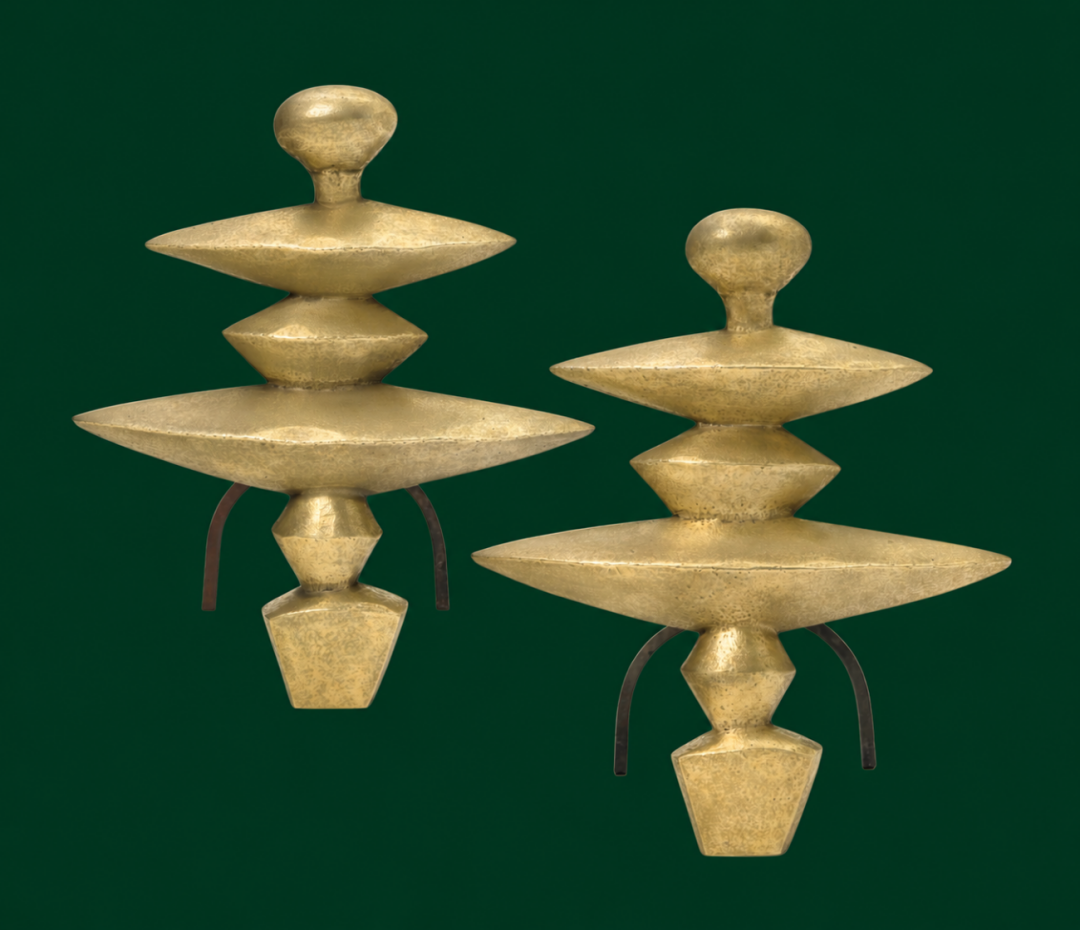
The andirons offer an especially compelling illustration of this conviction. Their function is domestic, but their conception is sculptural. Their presence is architectural, yet their appeal is fundamentally tactile and visual. They belong to the history of the fireplace, but equally to the history of modern sculpture. The present pair, described as Pair of andirons (ball-top), 1933, is particularly telling in this context.
Executed in gilt and patinated bronze, monogrammed AG and numbered 09 by the Giacometti Committee, the objects measure 34 × 46 × 28.5 centimetres. They are recorded in the Alberto Giacometti Database (AGD), maintained by the Alberto and Annette Giacometti Foundation, under reference number 4844.. Their provenance is given as a private Swiss collection. The accompanying documentation includes a certificate from the Giacometti Committee, Paris, dated 2026. An estimate of CHF 250 000–350 000 places the pair firmly within the international market for important twentieth-century design and sculpture.
Yet the interest of these objects extends far beyond their monetary value. Their story leads us into the world of Giacometti's artistic imagination, the exceptional creative partnership with Jean-Michel Frank, and the extraordinary interiors commissioned by some of the most discerning collectors of the twentieth century.
One such interior was the celebrated drawing room of Nelson Rockeller (1908-1979) – former vice president of the United States and previously governor of New York – at 810 Fifth Avenue in New York.
There, a remarkable ensemble of modern art and decorative design brought together the work of Henri Matisse, Fernand Léger, Pablo Picasso, Jean-Michel Frank and the Giacometti brothers. This association gives the history of these andirons an additional dimension.
They belong to a moment when the fireplace, traditionally the architectural and symbolic centre of the domestic interior, became a setting for the most adventurous expressions of modern artistic culture.
To understand them properly is therefore to enter a world in which sculpture was no longer confined to the museum pedestal. It had entered the residence. And, in the case of Giacometti's andirons, it had entered the fire.
Alberto Giacometti: A Swiss Artist in Paris
Alberto Giacometti was born on 10 October 1901 in Borgonovo, in the Swiss canton of Graubünden, close to the Italian border. He grew up in an artistic family. His father, Giovanni Giacometti, was an accomplished painter associated with the Swiss post-Impressionist tradition. His family environment provided an early introduction to the visual arts and encouraged his interest in drawing, painting and sculpture.
The landscape of the Engadine, with its dramatic mountains, changing light and austere architectural traditions, would remain an important part of his imaginative world.
In 1922, Giacometti moved to Paris to continue his artistic education. The city was then at the centre of an extraordinary international artistic transformation. The years following the First World War had produced an unprecedented concentration of artistic movements and personalities. Cubism had challenged the traditional representation of space; Dada had questioned the very definition of art; and Surrealism was beginning to explore the unconscious and the irrational.
Giacometti entered this environment with an exceptionally open mind. His early work developed through an engagement with different artistic traditions, including Egyptian sculpture, African art, Cubism and the experimental vocabulary of Surrealism. These influences were not simply borrowed stylistic devices. He examined the formal principles underlying objects from different cultures and periods, seeking ways to transform them into a personal sculptural language. This ability to move between historical reference and modern invention would become one of the defining characteristics of his decorative production.
By the end of the 1920s, Giacometti was becoming increasingly recognised in Parisian artistic circles. His Surrealist sculptures attracted attention for their unusual forms and provocative titles. Yet he was also developing another, less widely understood aspect of his practice: creating objects intended for actual use. It is important not to interpret this development as a departure from sculpture.
For Giacometti, the difference between an autonomous sculpture and a utilitarian object was less absolute than contemporary artistic conventions might suggest. A vase, a lamp or a fireplace accessory could provide the same opportunity for formal investigation as a sculpture intended for exhibition. Indeed, the practical requirements of an object sometimes offered additional possibilities.
A lamp had to occupy a particular space and provide illumination. A vase had to contain flowers. An andiron had to stand securely beside a fireplace. These functional considerations did not restrict Giacometti's imagination. They gave it a new framework. The object had to work, but it also had to possess an independent artistic presence. This balance between function and artistic expression would become especially important in his collaboration with Jean-Michel Frank.
Giacometti was not creating historical pastiches. He was absorbing the visual language of earlier cultures and transforming it into something entirely personal. The same approach can be considered in relation to the andirons. The fireplace itself is one of the oldest elements of domestic architecture. Throughout history, its accessories have been subject to changing fashions, from elaborate ironwork to highly ornamental brass and bronze designs.
Giacometti approached this tradition with the eye of a sculptor. The andiron was not merely a piece of metalwork. It offered an opportunity to investigate balance, volume, surface, repetition and the relationship between two related forms. Its position beside the fire also gave it a particular architectural significance. Unlike a small sculpture placed on a table, an andiron belongs to the lower visual field of a room. It is encountered close to the floor, in relation to the hearth, the fireplace surround and the furniture arranged around it. Its scale must therefore be considered in relation to the architecture. This makes the design of a pair of andirons a particularly demanding exercise. They must possess sufficient visual weight to hold their own within the composition of a room, while remaining subordinate to the fireplace itself.
Giacometti's genius lay in his ability to transform this practical requirement into an artistic opportunity.
By ALAN NAZAR IPEKIAN
AUCTION PREVIEWS, GENEVA
6 November, from 12noon to 7pm
7 & 8 November, from 12noon to 4pm
Hôtel d'Angleterre, Quai du Mont-Blanc 17
* * *
3, 4, 5 & 6 December, from 12noon to 7pm
PIGUET, Rue Prévost-Martin 51
* * *
AUCTIONS, GENEVA
7, 8, 9 & 10 December
PIGUET, Rue Prévost-Martin 51
* * *
CATALOGUES
By Post: +41 22 320 11 77