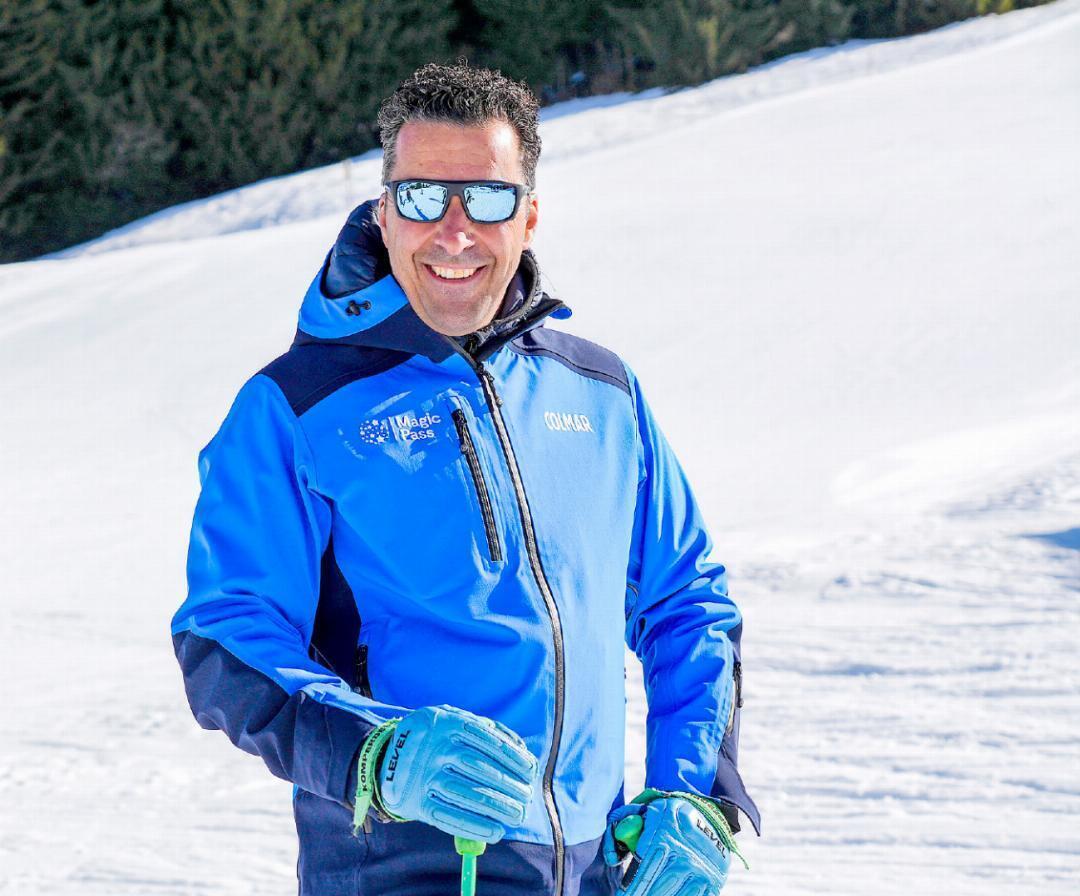


The Magic Pass is aimed primarily at urban residents without second homes
25.03.2026 Business
With 320,000 subscribers, revenues of around CHF 128 million and a steadily expanding network, the Magic Pass continues to reshape ...
With 320,000 subscribers, revenues of around CHF 128 million and a steadily expanding network, the Magic Pass continues to reshape Switzerland’s ski market. CEO Sébastien Travelletti explains why Gstaad benefits from joining, how revenues are shared, and why smaller ski areas remain essential.
For the Gstaad region, this winter marks its first season as part of the Magic Pass network — and the early figures point to a clear shift. By the end of February, Gstaad recorded an increase of around 33% in first-time entries. Across the wider Bernese Oberland, however, numbers were slightly down, suggesting a redistribution of visitors within the region.
According to Travelletti, this reflects the original strategy behind the pass. “From the outset, the Magic Pass was designed for urban residents without second homes,” he explains. “For them, it offers flexibility, access to multiple destinations without being tied to just one.”
This approach initially focused on smaller ski areas close to cities such as Bern, Fribourg and Lausanne. The model proved successful, eventually attracting larger destinations like Gstaad.
Today, the Magic Pass counts around 320,000 subscribers, with long-term potential estimated at 500,000. In the canton of Bern alone, roughly 70,000 passes were sold for the 2025/26 season, notably more than half of which were sold to residents outside the Bernese Oberland.
Balancing growth and selectivity
Expansion, however, is not simply about adding more resorts. Travelletti emphasises that each new destination must bring access to new guest markets. “It’s not about numbers alone,” he says. “We analyse whether a destination adds real value to the network.”
This includes assessing potential visitor flows, revenue generation and the financial stability of the ski area. Gstaad, for example, generates a high number of first-time entries, a key metric in the system, making it a strong contributor to overall turnover.
Why smaller resorts still matter
While major destinations draw attention, smaller ski areas remain fundamental to the Magic Pass ecosystem. Particularly in regions such as the Jura or areas close to cities, they serve as entry points for families and beginners.
“These areas are where many people learn to ski,” says Travelletti. “Later, they often move on to larger resorts. That progression is essential for the long-term health of the entire system.”
A more complex network
With nearly 100 destinations now included, managing the balance within the network has become more challenging. Differences in performance can create tensions, particularly when some resorts attract significantly more visitors than others.
At the same time, not every destination benefits equally every season. “Our role is to distribute risk while maintaining overall attractiveness,” Travelletti notes. “The system has to work for everyone.”
How revenues are distributed
The Magic Pass operates on a two-tier model. A fixed portion of revenue — around one third — is paid out in advance as a guarantee, providing financial planning security for participating resorts.
The remaining revenue is distributed based on first-time entries. Each time a pass holder enters a ski area for the first time on a given day, that visit generates points linked to the official day-pass price. The higher the ticket price, the higher the number of points — and the larger the share of revenue allocated to that destination.
Debate around pricing and pressure on infrastructure
Critics have argued that the Magic Pass risks devaluing skiing through lower prices. Travelletti rejects this: “We’re not lowering prices — we’re changing the business model. The average revenue per visit is not lower; there are simply more visits overall.”
In Gstaad, reactions remain mixed. While many welcome increased visitor numbers and higher revenues, others point to traffic congestion, full car parks and longer waiting times on peak days.
Travelletti acknowledges these concerns but places them in context. Peak congestion tends to occur on the same high-demand days as before — during holidays or in February — while midweek visitor numbers, often driven by families and seniors, provide valuable baseline occupancy.
“Higher revenues ultimately benefit the entire destination,” he says, pointing to long-term investments in infrastructure and lifts. “But these effects take time. In three to four years, the impact will be much clearer.”
Strong growth and new developments
At a media conference last week, Magic Pass organisers confirmed a total of 321,000 subscriptions sold — a 63% increase year-on-year. Despite this growth, no price increase is planned.
Geographically, expansion has been particularly strong in central Switzerland, with significant gains in cantons such as Lucerne and Obwalden. Summer usage is also growing: in 2025, the pass recorded over 960,000 entries, more than double the previous year, now accounting for around 20% of annual use.
Looking ahead, the next phase focuses on consolidation, with moderate growth of around 3% targeted for the 2026/27 edition.
Public transport integration
One of the most notable upcoming changes is the integration of public transport. From November 2026, pass holders will be able to use five return journeys by public transport from their home to a Magic Pass destination — included in the subscription.
Developed in collaboration with RailAway and the Alliance SwissPass, the initiative aims to reduce individual car traffic and ease congestion in resort areas.
“We want to encourage people to travel to the mountains by public transport,” Travelletti told SRF — a move that could help address the kind of traffic pressures seen in several Alpine destinations in recent winters.
Overall, the Magic Pass continues to evolve, not by lowering prices, but by redefining how ski tourism is structured, who it targets, and how destinations share both risks and rewards.
Based on AvS | JOP