

A Summer of Flowers
19.06.2026 Lifestyle
Each spring, the hillsides above Montreux are briefly blanketed in narcis sus so dense that the display has become known as the "May snow." It is one of Switzerland's celebrated natural spectacles and a reminder of just how dramatically flora can define a landscape. If you get a chance to ...
Each spring, the hillsides above Montreux are briefly blanketed in narcis sus so dense that the display has become known as the "May snow." It is one of Switzerland's celebrated natural spectacles and a reminder of just how dramatically flora can define a landscape. If you get a chance to see it, I guarantee you won't be disappointed.
Growing wild
Closer to home, the meadows, slopes and forests of the Saanenland have their own botanical character which has been influenced by altitude, the seasons and by centuries of farming practices that helped preserve the biodiversity we still see today. Traditional haymaking, with its late cuts and minimal intervention, allowed wildflowers to seed and return year after year. The result is a region where alpine gentians still dot high meadows in deep blue and where pasque flowers push through stony grassland as the last snow retreats. Pay attention and you'll find the seasons written in the plants as much as in the weather. For me, spring has properly arrived when cowslips start to cluster along the banks beside the river path.
Wildflowers have also long held a practical role in mountain life. In alpine areas of Switzerland, plants such as gentian, arnica, yarrow and thyme were commonly gathered for teas, ointments and traditional remedies. Arnica was applied to bruises and muscle pain, yarrow used to reduce fever, thyme taken for coughs and chest complaints. This was not folk superstition; many of these uses have since been validated by modern research.
Local knowledge about these plants formed part of rural life and was passed through the generations, reflecting how closely communities lived with the landscape. That relationship between people and plants didn’t disappear with modernisation as many of these herbs are still grown in kitchen gardens and sold in local pharmacies today.
The art of detail
It is this world that botanical painter Katharine Amies has spent her career observing. Botanical art demands a particular kind of patience: the willingness to look at a single subject long enough to understand not just its appearance, but its structure. Unlike other forms of painting, it requires scientific accuracy as well as artistic skill; a botanical illustration must be true to the plant, not just evocative of it. The discipline has a history stretching back to the great herbalists and explorers who needed accurate records of the plants they encountered.
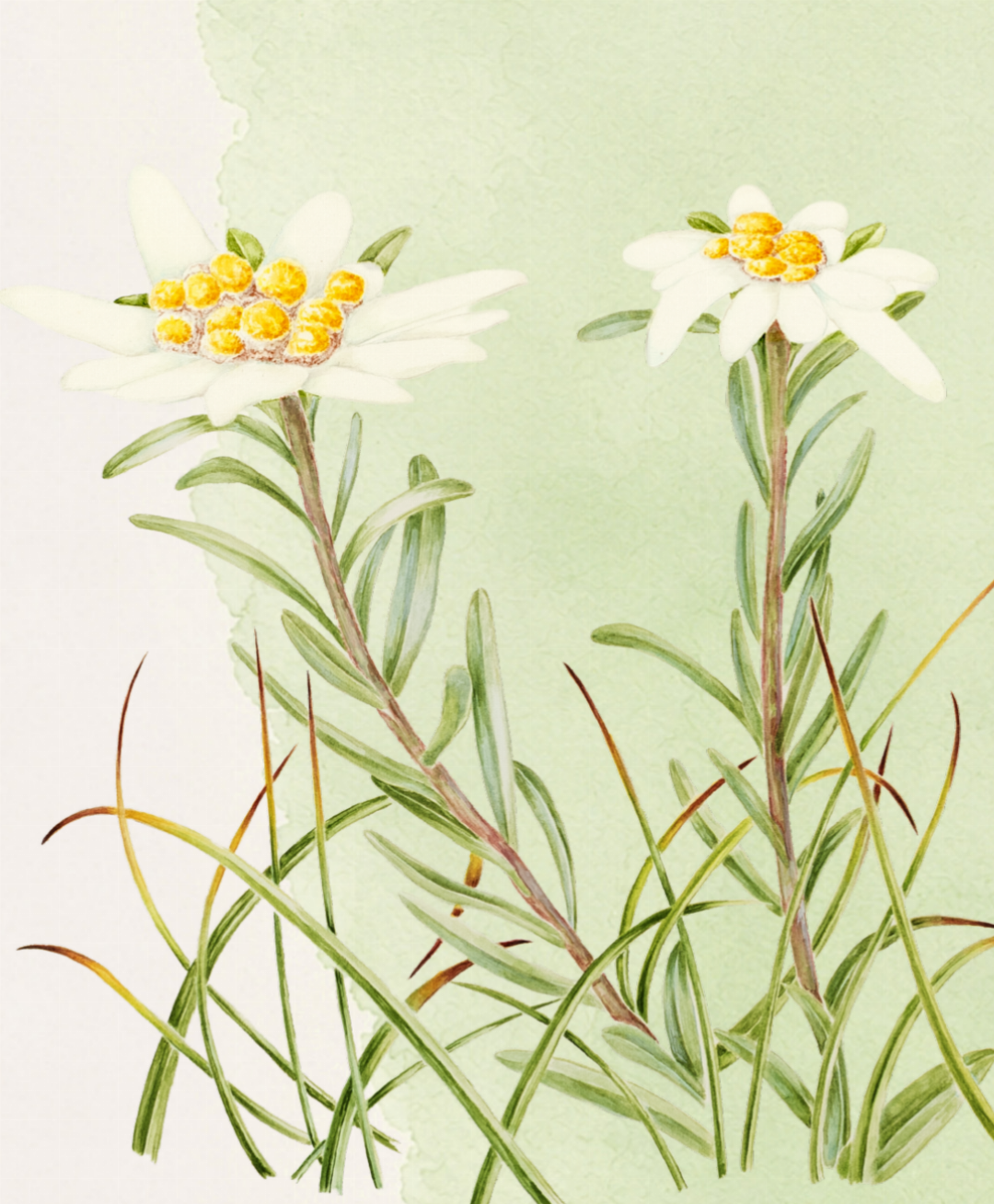
Over the four issues of GstaadLife this summer, we are delighted to share Katharine's work with you. Each issue will feature an original painting – edelweiss, red spruce, alpine gentian and pasque flower – drawn from the flora of this landscape.
Botanical painting asks us to slow down and consider not just what something looks like at a glance, but what it reveals under closer inspection. We hope that this summer, alongside enjoying Katharine's paintings, you'll also take a moment when you're out and about to look at the flowers growing around you. In a world that moves quickly, there is something calming about stopping to really notice a flower and ask what it may have meant to the people who found it growing here long before us.
ANNA CHARLES
EDELWEISS
Edelweiss is a small alpine plant that grows on dry, rocky slopes between about 1,500 and 3,000 metres. Its trademark ‘white star’ isn’t made of petals, but of soft, felted bracts. These white-tipped leaves surround tiny yellow florets, protecting them from cold, wind and intense high-altitude sunlight.
Named from the German edel
(noble) and weiss (white), it has long symbolised purity, bravery and steadfast love.
In 19th-century folklore, young men risked dangerous climbs to pick edelweiss as proof of courage and devotion.
Today, it’s protected in many regions, so if you spot one, the kindest thing is simply to admire it and leave it where it is.
ILLUSTRATION BY Katharine Amies
www.katharineamies.com
Follow on Instagram @katharineamies