



GSTAAD NEW YEAR MUSIC FESTIVAL
30.12.2025 Arts & Culture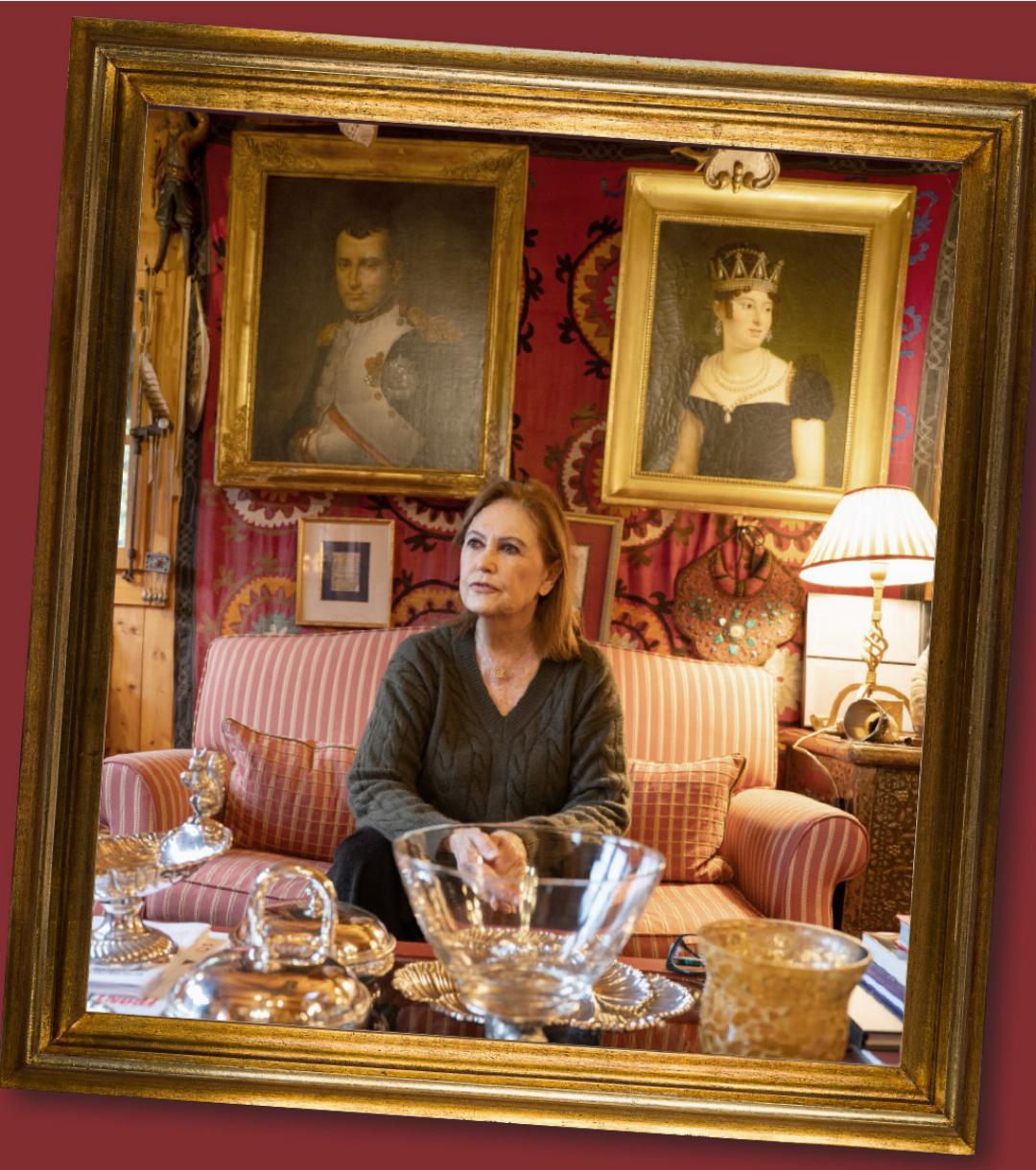
TWO DECADES OF VISION - THE MAKING OF GSTAAD'S MOST INTIMATE MUSIC FESTIVAL
When the Gstaad New Year Music Festival marks its 20th anniversary this winter, its founder and artistic director, pianist Caroline Murat, sees the milestone much like a personal rite of passage. “At twenty, you feel adolescence is over, you have become something,” she says. “For the festival, it’s the same. To reach twenty years is a proof of trust: artists trust us, patrons trust us, and the public believes in what we do.”
A festival built on ingenuity
The festival’s early years were shaped by scarcity and creativity. “We worked with very small budgets,” Murat recalls. “But when you have little, you must be inventive.”
One of her favourite memories comes from the Rougemont church: a dazzling Boléro de Ravel interpreted with 24 castagnettes, two pianos and a solo dancer. “It was extraordinary,” she says, and proof of how innovation can flourish precisely when resources are modest.
Today, the situation looks very different. “Now the biggest stars ask to sing here,” she says. “We are the only festival in Switzerland that dedicates more than two weeks exclusively to voice.”
A milestone year: From Bartoli to Domingo
The 20 th anniversary programme brings together opera, jazz, Broadway and choral music in ways that mirror Murat’s own wide-ranging musical identity.
The concert closest to her heart this year is the homage to Plácido Domingo. “His musicianship, his generosity, his technique, what he has given to music is immense. It broke my heart to see him driven out of opera houses. At 85, he still sings beautifully. Any musician must recognise what he has contributed.”
Another anchor point of the season is Cecilia Bartoli, appearing with Les Musiciens du Prince, a symbolic gesture, Murat explains, that links the festival to its longtime patron, Prince Albert II of Monaco, who assumed the throne the same year she founded the festival.
And jazz now forms a distinct chapter of the programme: from ragtime with New York pianist Aaron Diehl, to movie music with Joachim Horsley, to Musicals in the voice of Golda Schultz. “For me, good music is good music,” Murat says. “Jazz should be compulsory in every classical festival.”
Championing the next generation
One of the constants of the GNYMF is Murat’s instinct for identifying talent on the cusp of international breakthrough, something she honed during her years helping to build the Verbier Festival Academy.
This season’s rising star is Spanish tenor Xavier Anduaga, whom she booked long before critics in New York hailed him as “the greatest tenor today.”
Another major debut comes from dramatic soprano Anastasia Bartoli, who began her career as a hard-rock singer and now triumphs in Rossini. Her appearance is particularly symbolic: Murat chose a young artist, not a replacement star, to step in for Nadine Sierra, who is resting her voice. “Everyone is happy,” she says. “And giving an opportunity to a young artist, that is the ethos of the festival.”
The power of small spaces
Perhaps the most distinctive signature of the GNYMF is its insistence on intimacy. Great stars perform not in tents or grand halls, but in small Alpine churches.
For the musicians, it can be a revelation. Murat recounts how one renowned tenor panicked during rehearsal in tiny Rougemont: “But it’s so small!” he said, only to tell her afterwards that seeing his audience for the first time in a decade was “the greatest gift.”
Roberto Alagna once sang 45 minutes of encores in Saanen because he simply didn’t want the concert to end. “Those moments justify all the effort,” Murat says. “The artists know I do this for the love of music. It is not a business.” For first-time listeners, she recommends Golda Schultz’s 8 January concert, “because it is the easiest bridge between classical and jazz, Gershwin, Broadway, American songs, and just one or two arias from the big repertoire.”
When a Festival reaches outward
The festival’s commitment to openness shows in its three free concerts (Rougemont on 1 January, and Château d’Oex and Saanen on 10 January with the pianist Elizabeth Sombart playing the famous Mozart’s concertos 21 & 23) and complimentary entry for under-25s. “We want to build a new public,” Murat says. “In New York, the opera is full of young people. I hope we will see the same here.”
A particularly meaningful project is her attempt to bring music directly into local retirement homes, something she speaks about with moving urgency: “The elderly are too often treated like they have no mind, no dignity. Music can help people with Alzheimer’s, with
Parkinson’s, and with loneliness. Last year, we invited them for free, but this year we are going to them.”
The organisation of these concerts has been fraught: promised funding evaporated, a coordinator left abruptly, and costs remain uncovered. “It’s a wonderful project,” she says. “But without help, we cannot do it.”
Running a major festival without a formal office
One of the enduring mysteries of the GNYMF is how it continues to exist. There is no office, no permanent staff, no institutional sponsor – just Murat, her home dining table, the communication team, plus three technicians who arrive on 26 December each year.
“I prepare everything myself – travel, hotels, fees, budgets, etc. I don’t sleep the last two months,” she laughs. “It would be easier with an office. But I prefer fantastic concerts to office costs.” With singers being the most expensive artists in classical music, every patron matters. And Murat is frank about the economics: “Without the Club des Amis, we could forget the festival. Even 300 francs from a friend helps enormously.”
Her philosophy is shaped by a long career in music, and by disillusionment with how money often circulates in the arts. “In charity, too often the donors pay for the dinner, not the cause. Here, the money goes directly to the music. Musicians need to eat.”
A personal arc – from Verbier to Lauenen
Murat speaks with deep affection of her artistic mentor Martin Engström, founder of the Verbier Festival, who urged her to create her own festival. “Without him, I would never have thought of it. Verbier showed me the way.”
But it is Lauenen that gives her the clarity to run it. “Each time I arrive and see the mountains, something calms inside me. It is my paradise,” she says. She and her husband bought their house ten years ago, after decades of returning to the valley. “When I come from New York, where everything is money, success, image, I breathe again here. I become myself.”
The New Year Music Festival is, at heart, a portrait of its founder: uncompromising, intimate, fiercely devoted to beauty over bureaucracy. Its 20th anniversary is not just a milestone but an affirmation that music – real music, shared in close quarters – still matters.
As Murat says, “I will rest in the cemetery. Until then, I want to work, to create, to bring music to people, wherever they are.”
See the full program on gstaadnewyearmusicfestival.ch
BY JEANETTE WICHMANN