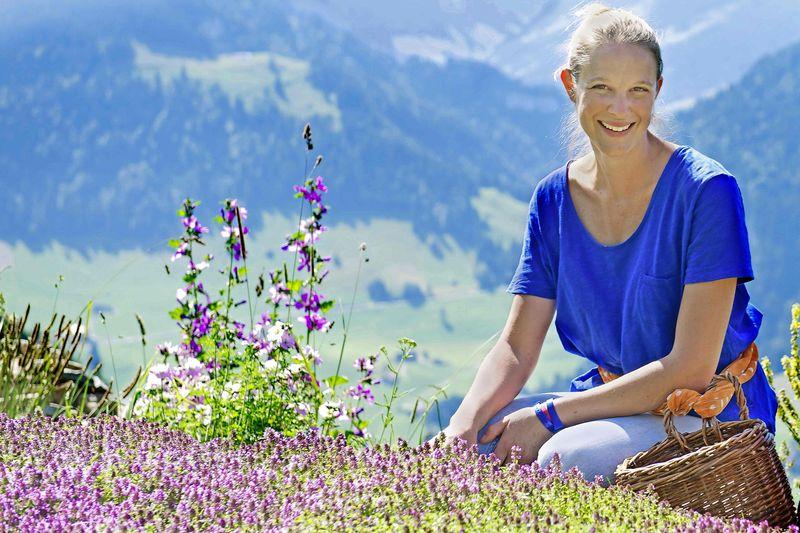
Inside the charming wooden chalet surrounded by fragrant greenery, we sat down for a discussion of the history of this unique spot, and how Landolt-Nardin and her two partners Laeticia Jacot and Sandy Menoux created this self-styled herbal pharmacy of the mountains known as the Herboristerie de Montagne.
A bounty for natural remedies, Switzerland is home to many herbs, grasses, and flowers with medicinal properties. At Jardin des Monts, flowers are both picked wild and cultivated on steep terraces high above Rossinière. After harvesting, the fragrant, dried plants are used in a collection of creams and oils, as well as teas, syrups, and even chocolate.Sipping a refreshing thyme syrup and spring water, Landolt-Nardin led me through the unusual sight, tastes, and smells of the alpine terrain.
GL: How and why did you come to the Pays-d’Enhaut
CLN: This region is close to my father’s heart. He came here with his grandfather on summer trips from Lausanne. They went on all kinds of adventures, and he taught my father how to appreciate and respect nature. My grandfather bought the Reserve de la Pierrereuse and my father brought us there when we were children, continuing the tradition for the next generation. We hiked and learned about nature and I also fell in love with the beauty of the region.
GL: When was Jardin des Monts founded?
CLN: We came here in 2005, but things really took off when Laetitia Jacot joined the project. In 2006 we had to determine which herbs grew best at which levels on the property. We investigated which kinds of wild plants also grew nearby. This way, we can pick wild flowers and herbs, and also cultivate our own production.
GL: How did you meet Laetitia Jacot, your good friend and business partner?
CL: Laetitia and I met at horticultural school in Morges but didn't get close until we met again here in the Pays-d’Enhaut. In 2006, we became fast friends and I invited her to build the business with me. Laetitia has specialized knowledge in herbs, which I do not have, and is really the one who is responsible for the creative development of the herbal products.
GL: Do I hear mooing?
CLN: Yes! Christian Jaggi takes care of our small herd of goats and three rare Hinterwald cows. He milks them and makes the cheese we produce for sale in limited quantities.
GL: When did your third partner enter the business?
CL: In 2009, Sandy Menoux joined our team, and has helped build the brand with business development, marketing, and public relations. We are like the three musketeers –we all come to a consensus when making new decisions for the company.
GL: Is Jardin des Monts available worldwide?
CLN: We have 100 selling points all over Switzerland. We are still a small operation and the brand isn’t big enough to be marketed worldwide. We’re going step by step and growing the company slowly so we keep our family atmosphere and approach.
In the Saanenland and Pays-d'Enhaut regions, our products are available at Pernet, the Palace, and a few shops in Château-d’Oex as well as l’Etivaz.
Last year we started selling in German-speaking Switzerland and even have some availability in Ticino.
GL: This chalet is beautifully preserved. What can you tell me about its history?
CLH: The home was built in 1850 by a Lucernois who came with this family to live year-round, which was uncommon for the region. Typically people had a chalet in the valley for fall and winter, a little chalet a bit higher up, and a last hut high up on the mountaintop for grazing in the height of summer.
The architectural style is quite typical of the Entlebuch valley region, as is the size. The farm’s terraces were originally used for grains and vegetables…it’s where we grow our herbs today.
GL: Is Jardins des Monts exclusively organic?
CLN: We were certified organic in 2008. This place was untouched for many years but in Switzerland a two-year waiting period for certification for new farms is obligatory.
GL:How did you decide on which herbs to grow?
CLN: Medicinal herbs were important to us, which are useful for many ailments. We even visited local grandmothers and took a look at what was in their natural medicine cabinets. We have a wide variety of herbs and flowers at the farm, including some of our most popular additions to products like thyme, edelweiss, and mint. For example, three types of mint–Moroccan, Peppermint, and green mint–are all good for digestion and have been used in the region as a home remedy after meals.
GL: I’ve heard it isn’t easy to grow edelweiss. Is this true?
CLN: Not exactly. Edelweiss is rare and grows wild at only high altitudes. We have a small batch of the protected flower here which requires lots of sun and good, rocky soil. It’s actually a very hardy little flower.
GL: Tell us about your expansion.
CLN: We started selling in the Pays-d’Enhaut and then the products became so popular we decided to expand. Jardin des Monts now has several lines: Chocolate produced with our partner Early Beck, syrups and teas made exclusively with our mountain herbs, and cosmetics. In the fall we’ll debut herbal gummy candies as well.
GL: Do you offer a full range of cosmetics?
CLN: The base of our cosmetic product line is made by a Swiss firm, and then we add the active ingredients which are all made here on the farm. This includes several products made with edelweiss, like lip balm and body butter. The only thing we don't have yet is a dedicated cream for the face.
GL: What about the pine trees that grace the mountaintops here?
CLN: White pine is used to invigorate and it’s a key ingredient in our energising scrub and body oil. It can also be used like a Vicks vapour rub, to help clear the sinuses and loosen chest congestion, especially during wintertime.
GL: What else do your products do?
CLN: We also have calming herbs. Marjolaine is relaxing and is found in our bath salts and creams. Calendula is another popular herb, used in our liquid soaps for face and body. It’s very gentle and great for children’s sensitive skin.
Thanks to the Gstaad Palace, which is a very supportive partner, we were able to develop special treatments with their massage staff using our organic oils.
GL: Are all the components of your products locally sourced?
CLN: Whenever possible, we work with partners from the region, but we definitely don't go outside Switzerland for any ingredients. Today we have several women near Rossinière who have been with us for four years growing small batches of herbs for use in our products.
GL: You’re Swiss and French, and a Rosey graduate, no?
CLN: I am indeed. I grew up on a farm in Brazil but came back to Switzerland for secondary schooling at Le Rosey. I had an ideal childhood in Northeastern Brazil–my father had cows and kennels, and made lots of cheese, selling it throughout the country. We had mangoes and all sorts of local fruit too.
GL: What do you think about the movement towards a more natural lifestyle?
CLH: I think it’s a good thing, and about time. There are many ways to get close to nature and appreciate the natural world, especially in Switzerland.
Inside the charming wooden chalet surrounded by fragrant greenery, we sat down for a discussion of the history of this unique spot, and how Landolt-Nardin and her two partners Laeticia Jacot and Sandy Menoux created this self-styled herbal pharmacy of the mountains known as the Herboristerie de Montagne.
A bounty for natural remedies, Switzerland is home to many herbs, grasses, and flowers with medicinal properties. At Jardin des Monts, flowers are both picked wild and cultivated on steep terraces high above Rossinière. After harvesting, the fragrant, dried plants are used in a collection of creams and oils, as well as teas, syrups, and even chocolate.Sipping a refreshing thyme syrup and spring water, Landolt-Nardin led me through the unusual sight, tastes, and smells of the alpine terrain.
GL: How and why did you come to the Pays-d’Enhaut
CLN: This region is close to my father’s heart. He came here with his grandfather on summer trips from Lausanne. They went on all kinds of adventures, and he taught my father how to appreciate and respect nature. My grandfather bought the Reserve de la Pierrereuse and my father brought us there when we were children, continuing the tradition for the next generation. We hiked and learned about nature and I also fell in love with the beauty of the region.
GL: When was Jardin des Monts founded?
CLN: We came here in 2005, but things really took off when Laetitia Jacot joined the project. In 2006 we had to determine which herbs grew best at which levels on the property. We investigated which kinds of wild plants also grew nearby. This way, we can pick wild flowers and herbs, and also cultivate our own production.
GL: How did you meet Laetitia Jacot, your good friend and business partner?
CL: Laetitia and I met at horticultural school in Morges but didn't get close until we met again here in the Pays-d’Enhaut. In 2006, we became fast friends and I invited her to build the business with me. Laetitia has specialized knowledge in herbs, which I do not have, and is really the one who is responsible for the creative development of the herbal products.
GL: Do I hear mooing?
CLN: Yes! Christian Jaggi takes care of our small herd of goats and three rare Hinterwald cows. He milks them and makes the cheese we produce for sale in limited quantities.
GL: When did your third partner enter the business?
CL: In 2009, Sandy Menoux joined our team, and has helped build the brand with business development, marketing, and public relations. We are like the three musketeers –we all come to a consensus when making new decisions for the company.
GL: Is Jardin des Monts available worldwide?
CLN: We have 100 selling points all over Switzerland. We are still a small operation and the brand isn’t big enough to be marketed worldwide. We’re going step by step and growing the company slowly so we keep our family atmosphere and approach.
In the Saanenland and Pays-d'Enhaut regions, our products are available at Pernet, the Palace, and a few shops in Château-d’Oex as well as l’Etivaz.
Last year we started selling in German-speaking Switzerland and even have some availability in Ticino.
GL: This chalet is beautifully preserved. What can you tell me about its history?
CLH: The home was built in 1850 by a Lucernois who came with this family to live year-round, which was uncommon for the region. Typically people had a chalet in the valley for fall and winter, a little chalet a bit higher up, and a last hut high up on the mountaintop for grazing in the height of summer.
The architectural style is quite typical of the Entlebuch valley region, as is the size. The farm’s terraces were originally used for grains and vegetables…it’s where we grow our herbs today.
GL: Is Jardins des Monts exclusively organic?
CLN: We were certified organic in 2008. This place was untouched for many years but in Switzerland a two-year waiting period for certification for new farms is obligatory.
GL:How did you decide on which herbs to grow?
CLN: Medicinal herbs were important to us, which are useful for many ailments. We even visited local grandmothers and took a look at what was in their natural medicine cabinets. We have a wide variety of herbs and flowers at the farm, including some of our most popular additions to products like thyme, edelweiss, and mint. For example, three types of mint–Moroccan, Peppermint, and green mint–are all good for digestion and have been used in the region as a home remedy after meals.
GL: I’ve heard it isn’t easy to grow edelweiss. Is this true?
CLN: Not exactly. Edelweiss is rare and grows wild at only high altitudes. We have a small batch of the protected flower here which requires lots of sun and good, rocky soil. It’s actually a very hardy little flower.
GL: Tell us about your expansion.
CLN: We started selling in the Pays-d’Enhaut and then the products became so popular we decided to expand. Jardin des Monts now has several lines: Chocolate produced with our partner Early Beck, syrups and teas made exclusively with our mountain herbs, and cosmetics. In the fall we’ll debut herbal gummy candies as well.
GL: Do you offer a full range of cosmetics?
CLN: The base of our cosmetic product line is made by a Swiss firm, and then we add the active ingredients which are all made here on the farm. This includes several products made with edelweiss, like lip balm and body butter. The only thing we don't have yet is a dedicated cream for the face.
GL: What about the pine trees that grace the mountaintops here?
CLN: White pine is used to invigorate and it’s a key ingredient in our energising scrub and body oil. It can also be used like a Vicks vapour rub, to help clear the sinuses and loosen chest congestion, especially during wintertime.
GL: What else do your products do?
CLN: We also have calming herbs. Marjolaine is relaxing and is found in our bath salts and creams. Calendula is another popular herb, used in our liquid soaps for face and body. It’s very gentle and great for children’s sensitive skin.
Thanks to the Gstaad Palace, which is a very supportive partner, we were able to develop special treatments with their massage staff using our organic oils.
GL: Are all the components of your products locally sourced?
CLN: Whenever possible, we work with partners from the region, but we definitely don't go outside Switzerland for any ingredients. Today we have several women near Rossinière who have been with us for four years growing small batches of herbs for use in our products.
GL: You’re Swiss and French, and a Rosey graduate, no?
CLN: I am indeed. I grew up on a farm in Brazil but came back to Switzerland for secondary schooling at Le Rosey. I had an ideal childhood in Northeastern Brazil–my father had cows and kennels, and made lots of cheese, selling it throughout the country. We had mangoes and all sorts of local fruit too.
GL: What do you think about the movement towards a more natural lifestyle?
CLH: I think it’s a good thing, and about time. There are many ways to get close to nature and appreciate the natural world, especially in Switzerland.