



Papercutting -- Traditional Handicraft Evolves into Contemporary Art
14.08.2015 Gstaad Living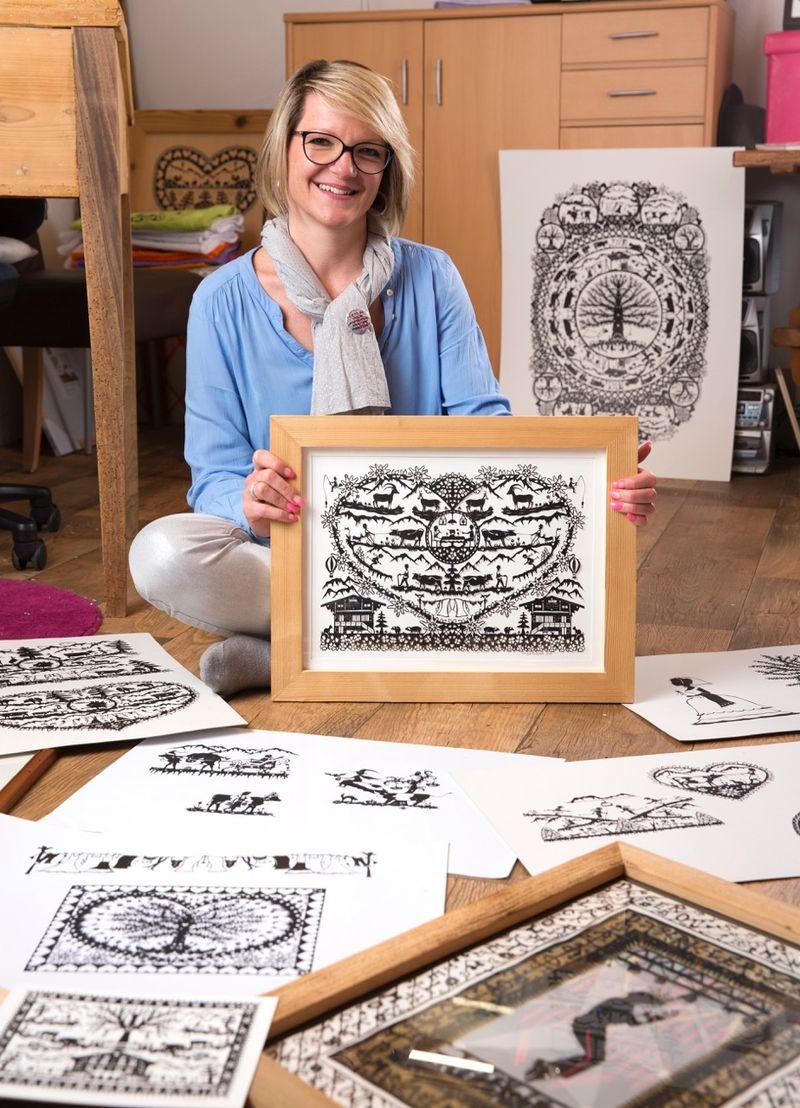
Although it is thought to have roots in China and the Middle East, the art dates back to the 18th century here in Switzerland, when young women from the upper classes were encouraged to take it up as a leisure activity.
Birthplace of Swiss Papercutting
The Pays-d’Enhaut is famous for its paper cuts and boasts an outstanding collection at the Musée du Vieux Pays-d’Enhaut in Château-d’Oex. The first great Swiss masters of the technique were from the region, which lies in Canton Vaud just down the valley from the Saanenland.
The two most revered local masters were Johann-Jakob Hauswirth (1809–1871) and Louis Saugy (1871–1953). They favoured alpine idylls like steep mountains, cows, and flower-strewn meadows in their artwork.
Traditional activities like cheese making and fetching well water also feature prominently in today’s pieces, which resemble delicate lace. However younger artists are transitioning modern details like high-heeled women and cityscapes into their motifs.
Steps to Completion
Artwork is usually cut from one single piece of paper, and intricate designs can take dozens of hours to complete. Several steps make up the process: First, the artist traces the design onto a sheet of paper which is black on one side and white on the other. Next, scissors or more often small, sharp knives or scalpels are then used to cut out the tiny, detailed patterns.
As there is no school for paper cutting in Switzerland, the few who specialise in the art are mostly self-taught. Creativity is on the rise, with more and more artists eschewing traditional designs for those a bit daring. Alternatively, colours other than the standard white or black are
being used to infuse the folksy scenes with a touch of modernity.
Papercutting Renaissance
Corinne Karnstädt is one of the new generations of paper cutters–she luckily manages to eek out an existence on her art alone. After inheriting her grandmother’s house in Rossinière, she relocated from Lausanne to the Pays-d’Enhaut, where she has a small studio dedicated to her art. In an attempt to bring the old-fashioned activity to a new audience, Karnstädt hosts free demonstrations followed by low-cost initiation classes every Tuesday.
Another approach is taken by Frédéric Beziat, who has passed on paper to perform cutting on gold sheets. Beziat cuts away much in the same way Karnstädt does, turning out delicate heart-shaped
pendants with cut-out figures and scenes just like traditional papercutting.
With more than three decades of Saanenland visits behind him, Beziat says the area inspires him and his artwork frequently reflects this. He bills himself as a joaillier ebeniste or jeweler joiner, yet turned to gold as a medium for his designs, which are now available at Zwahlen-Hüni in Saanen.
Birthplace of Swiss Papercutting
The Pays-d’Enhaut is famous for its paper cuts and boasts an outstanding collection at the Musée du Vieux Pays-d’Enhaut in Château-d’Oex. The first great Swiss masters of the technique were from the region, which lies in Canton Vaud just down the valley from the Saanenland.
The two most revered local masters were Johann-Jakob Hauswirth (1809–1871) and Louis Saugy (1871–1953). They favoured alpine idylls like steep mountains, cows, and flower-strewn meadows in their artwork.
Traditional activities like cheese making and fetching well water also feature prominently in today’s pieces, which resemble delicate lace. However younger artists are transitioning modern details like high-heeled women and cityscapes into their motifs.
Steps to Completion
Artwork is usually cut from one single piece of paper, and intricate designs can take dozens of hours to complete. Several steps make up the process: First, the artist traces the design onto a sheet of paper which is black on one side and white on the other. Next, scissors or more often small, sharp knives or scalpels are then used to cut out the tiny, detailed patterns.
As there is no school for paper cutting in Switzerland, the few who specialise in the art are mostly self-taught. Creativity is on the rise, with more and more artists eschewing traditional designs for those a bit daring. Alternatively, colours other than the standard white or black are
being used to infuse the folksy scenes with a touch of modernity.
Papercutting Renaissance
Corinne Karnstädt is one of the new generations of paper cutters–she luckily manages to eek out an existence on her art alone. After inheriting her grandmother’s house in Rossinière, she relocated from Lausanne to the Pays-d’Enhaut, where she has a small studio dedicated to her art. In an attempt to bring the old-fashioned activity to a new audience, Karnstädt hosts free demonstrations followed by low-cost initiation classes every Tuesday.
Another approach is taken by Frédéric Beziat, who has passed on paper to perform cutting on gold sheets. Beziat cuts away much in the same way Karnstädt does, turning out delicate heart-shaped
pendants with cut-out figures and scenes just like traditional papercutting.
With more than three decades of Saanenland visits behind him, Beziat says the area inspires him and his artwork frequently reflects this. He bills himself as a joaillier ebeniste or jeweler joiner, yet turned to gold as a medium for his designs, which are now available at Zwahlen-Hüni in Saanen.